Showing posts with label Mt. Vernon. Show all posts

Monday, August 5, 2013

The "Early American" Revolution: A War for Mid-Century Independence

When imagining the living rooms of the quintessential American TV families of the mid-20th Century - The Cleavers, The Mitchells, The Stones, The Williams, The Baxters, et al - one would be hard pressed to find in that dreamscape of design a starburst, an amorphous coffee table, a George Nelson timepiece, a Barcelona chair, or anything even remotely resembling an Eames' design.

Speaking of seminal television families, what about the Ricardos?
With its braided rugs, wide-plank floors, and traditional furniture, 
Lucy & Ricky's country house was anything but "Mid Mod."

Maybe it was a conscious effort on the part of ultra-conservative television executives to pretend that American domesticity skewed decidedly toward the traditional OR maybe it was art imitating the reality of life.  Perhaps, if I may dare to conjecture, the design movement generally referred to as "Early American" was far more prevalent than the atomic shapes, patterns, and colors that abound in contemporary iterations of mid-century design schemes.  Speaking only from the experience of a) having two sets of grandparents with houses full of reproduction windsor and ladder-back chairs, turned-wood four poster beds, colonial secretary desks, and classically-styled spinets and b) seeing a glut of similar merchandise in resale establishments, garage/estate sales, and thrift stores far exceeding the availability of their "modern" counterparts, it seems as if "Early American" might have a had a larger audience than our romantic notions of popular culture history might have led us to believe.

Encountering this article in the November 1951 issue of Better Living Magazine, I was reminded 
of how strong a movement "Early American" design was.  So strong in fact, that the article just
 takes the major elements of the room for granted.  Not wasting a word on the paneled wall, the 
brick hearth with traditional molding and mantlepiece, the camelback sofa, the tilt-top tea table, 
the brass candlestick lamp with gilded eagle, the wingback chair, the hobnail glass, the chintz
 upholstery, or the classical symmetry of it all, the author focuses exclusively on the color 
scheme - red, white, and blue.

A patriotic color palette was indeed a unifying theme among Early American interiors, commonly accented by yellow and gold.  Other recurring elements included the use of metal accessories (copper, brass, pewter), mass-marketed reproductions of 18th and early-19th Century furniture, indications of primitive crafting (needlepoint, braided rugs, etc.), and electrified, antique light fixtures.

Pewter mugs hang above the hearth in a colonial blue room lit by a
counterweight desk lamp as the milk pail turned side table is under
 the ever-watchful eye of that EAGLE!
(Source)

My grandparents always had an eagle hanging in their house (usually
above the doorway) and it is one of the things that I have kept since
their passing.

I'll admit it, sometimes I get sucked in by the glamour of blonde wood and mobiles and starbursts and boomerangs, but I'm kind of hokey pokey at heart and I love the comfort and nostalgia of 1950's-does-1780's.  So much so, that I try to encourage other people to participate in these anachronistic design choices with me.

After visiting Mt. Vernon, I learned that brightly-painted woodwork was actually a
hallmark of Early American design.  The mid-tone wooden furniture, the rag rug,
the hardware on the doors, the wall sconces, and the saturated, coral-red paint are
 evocative of the early American spirit.
(Source)

But the battle is mostly uphill.  It took a lot of convincing to get my sister-in-law on board with the incredible, 1950's, Ethan Allen, sleeper sofa that my brothers and I found at a thrift store for $12.50!!!  Its beautiful red-and-blue plaid upholstery, wood trim, high back, and turned-wood spindles, were so contradictory to the streamlined, low-profile silhouettes of its contemporaries that it just seemed downright un-American  In actual fact, it screamed "Early American" so loudly, that we thought it was going to start another revolutionary war.  She quickly changed her tune when I found an Early American side table with a built in lamp fitted out with hurricane glass and one of those glorious, fluted/ruffled, fabric lamp shades.

My very favorite is when the two worlds, Early American and Mid-Century Modern, collide; in my travels I often see that ubiquitous icon of mid-century decor, the two-tired end table, executed with turned-wood legs and spindles and a scrolled apron.  The mash-up of competing styles is pure magic.

The barrel chair with turned wood spindles at the secretary, the red wingback, the paneled walls, the floral upholstery, the exposed ceiling beams, the braided rug, the tea service, and the brass light fixtures all speak to colonial America.
Nevertheless, you couldn't fool anyone into actually believing that this was a colonist's residence; it is early America viewed through the prism of post-War, patriotic nostalgia.  I love this room!

Having just defeated the enemy, America was on a post-WWII high, fueled by extreme optimism and unbridled patriotism.  That heady combination just might be the reason for the broad embrace of the stylistic elements of colonial America.  U-S-A! U-S-A! U-S-A! (Are you chanting with me?  Hahahahaha!!!)

Early American print on Barkcloth
(Source)


Sometimes rustic, sometimes refined, the Early American style wasn't just limited solely to sitting rooms; kitchens (don't you love those black strap hinges and Early American Pyrex?), bedrooms, and clothing trends were subject to the influence as well.  As a matter of fact, even eateries capitalized on the success of the colonial craze (see our coverage of  Colonial Kitchen in San Marino, CA).


The breakfast nook of an Early American style kitchen
(Source)

Mid-century/Early American style
serving tray from my collection.

Better Homes and Gardens - April 1951

So which do you prefer?

Colonial Casual?
(from my copy of Better Homes and Gardens - April 1951)
Or Federal Formal?
(from my copy of Women's Home Companion - April 1952)

Given that much of Early American design is rooted in tradition, it seems counterintuitive to highlight it in a wacky tacky post.  However, I think that amongst the current old-timey set it is so positively subversive to be such a fan of "Grandma Style" that it fits well within the realm of wacky tacky, don't you?  Sacrifice mirrored shadow boxes and boomerang coffee tables for wingbacks and decorative butter churns???  Oh, the horror!

Well, does the Early American style remind you of mom or grandma?  Do you think that there is a reason this style goes unappreciated?  Is it best forgotten?  I wonder if this style (along with other American exports of the time) became fashionable in other countries.  Non-US readers, please feel free to weigh in on the subject!


Cheers!

Mr. Tiny

Saturday, July 6, 2013

Mr. Tiny Goes to Washington

I had every intention of publishing a patriotic post for the 4th of July, but in preparing for the big day I was all consumed by shopping, cooking, and cleaning.  In the battle for independence, America was the victor.  In the battle for holiday precedence, hot dogs won the day.

It would have been entirely apropos for me to post this in a timely manner; after all, what better way to celebrate the independence of the United States of America than by visiting its capitol, Washington, D.C.?  As much as I wish Jean Arthur was there, I'm glad that I was able to visit as a tourist rather than a pawn in the corrupt machinations of corpo-political graft a la Jimmy Stewart in Mr. Smith Goes to Washington.  Nevertheless, I did feel a bit of Frank Capra's dichotomous reverence and revulsion for the workings of our political system as I wandered the busy streets of my nation's capitol (for the very first time) looking for the wacky tacky.

Mr. Smith Goes to Washington (1939)
Trailer

I know that there is much more to be seen than we were able to accomplish in just two days but we really got a solid primer of Washington, D.C. thanks to some last minute planning and a good friend.

MT. VERNON

The first stop on our whirlwind tour was actually outside of the city at the home of none other than George Washington, Mt. Vernon.  Nestled along the banks of the Potomac River, this country estate really did offer a view into the life of our first president and into early America.  Sadly, visitors are not allowed to take photos of the home's fascinating interior but images can be viewed here.

Mt. Vernon's Neoclassical facade was actually achieved through a technique called "rustication" (chiseling, painting, and applying pulverized sandstone to standard wooden siding to give the appearance of stone blocks)....seems like a lot of work.

A view from George & Martha's back porch

Mr. Tiny makes like Mr. President

Mt. Vernon Travel Tip:  The docents don't like when tour guests make reference to George Washington's flatulence when viewing his private bed chamber.  Nor do they like it when tour guests say, "Bye-bye, have fun at the glue factory," to a small herd of goats that have just been loaded up into a cart.

It goes without saying that the history and grandeur of Mt. Vernon were
built on the backs of slave laborers.  We saw where George Washington was
originally entombed and his current resting place; the most hallowed ground,
 however, was the plot of land filled with the unmarked graves of Mt. Vernon
 slaves.  As we stood there thinking about the troubling realities of American
 history, this turtle emerged from the graveyard - spooky and thrilling!!!

Since we were in the area, we also saw another historic home with presidential
provenance.  This is the house in which my mother spent her high school days.
The car port on the left was built by my grandfather using lumber reclaimed
from the platforms used at LBJ's inauguration.

THE WHITE HOUSE

It was kind of a progressive, presidential real estate tour.

THE SMITHSONIAN INSTITUTION

When I asked for recommendations on what to do in D.C., overwhelmingly the response was "The Smithsonian."  The Smithsonian Institution is comprised of many museums, galleries, and research centers so one could ostensibly spend many days in the exclusive pursuit of seeing each and every one of those facilities; we couldn't afford that luxury.  We did happen to be in town on the best possible day as the three museums (American History, Natural History, Portrait Gallery) that I had to visit were open late.  Gladly, we made it to all three.
  
A portrait of famous abolitionist, John Brown.
This looks a little too close to some of my
 immediate family members for comfort!


Beyond Kermit and Julia Child's kitchen, I had no idea what I'd be seeing at the
American History Museum.  Other visitors had no idea that the squeal I let out upon
seeing the fritillaries cape from Now Voyager from across the room was emanating
 from a grown man.  What can I say?  I love Hollywood history...and Frito's!!!

Some people want to meet the man who put the "Bop" in the
"Bop-shoo-bop."  I want to meet whomever signed off on this
stunning interpretation of wildlife - spread-eagle, giraffe taxidermy!

Mr. Tiny as ancient man...and wife.

THE CAPITOL BUILDING

One of our oldest family friends works as a political advisor for a senator and she arranged a private tour of the Capitol Building for our ragtag bunch.

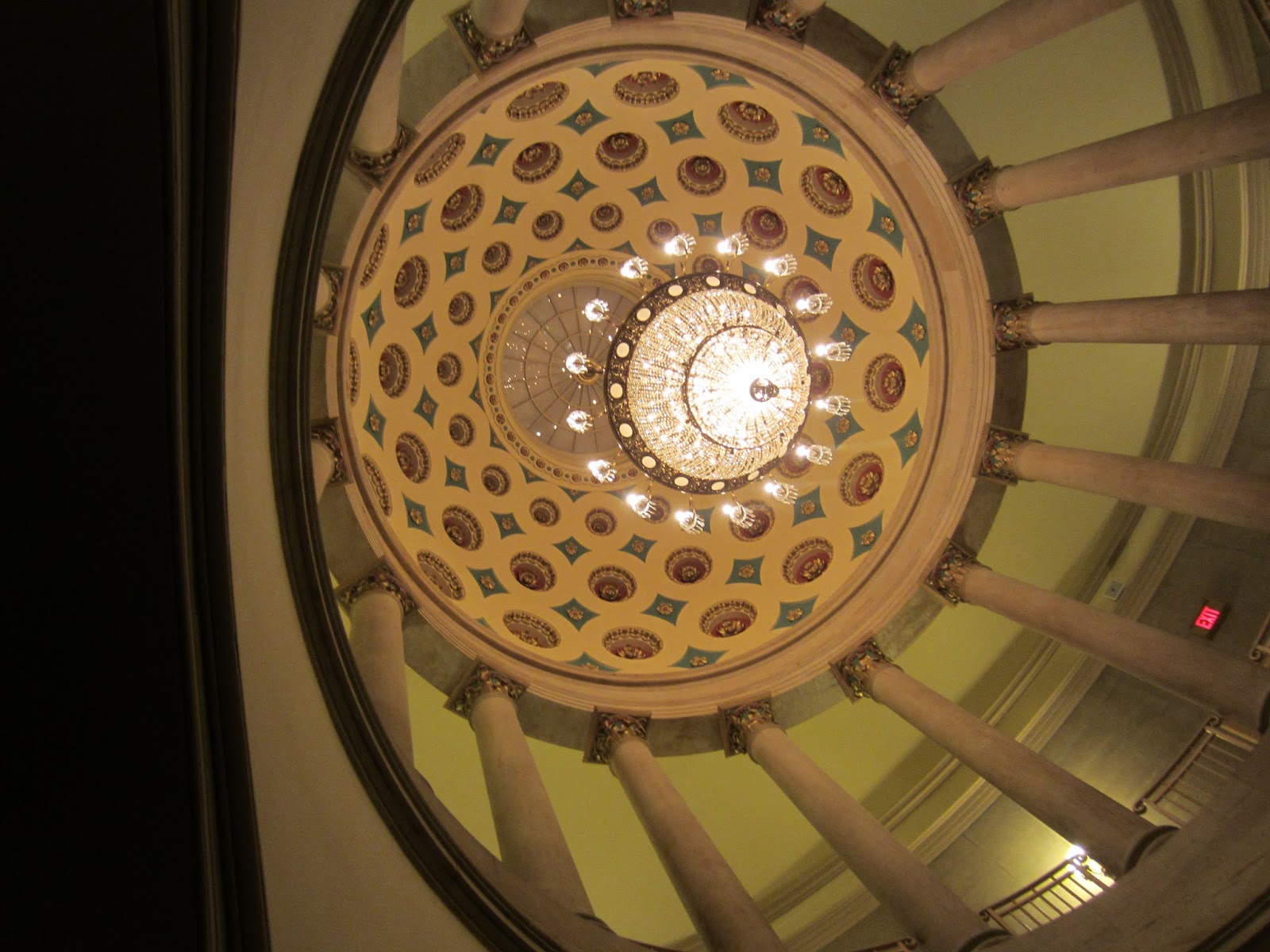
The Capitol Dome

The Capitol Building is beautiful and full of history but the most awesome part of our visit
 was the opportunity to ride in the underground subway/trolley reserved for senators
 (pages, interns, advisors, etc.) to get to and from their offices and Capitol Hill.

Corny cornice???
Technically, it is the "capital" but cornice sounds better, doesn't it?

"Dome" seems to be the operative word; they're everywhere!


Inside the Capitol Dome
It is interesting to recognize the inherent religious symbolism and the effort to deify George Washington.

LINCOLN MEMORIAL


My favorite part of the trip to Washington, D.C. and the moment I felt closest to Jimmy Stewart's character was visiting Abraham Lincoln.  Maybe I was getting overly dramatic but it became clear that this memorial was a place of redemption, a reminder that even great wrongs can be made right.  It was a place to acknowledge that every life has meaning. 

Mr. Lincoln & Mr. Tiny
I'm not too proud to say that I got a little (if altogether unexpectedly) weepy upon
meeting Mr. Lincoln.  I'm sure it is some combination of "Great Moments with Mr. Lincoln"
being one of my favorite attractions at Disneyland, the fact that Lincoln is one of America's most
venerated presidents, and my admiration for a man who used his life with real and significant
purpose.

It wasn't all solemnity though.
This blurry photograph is to show the Lincoln Memorial's incredible, if unintentional, marble slide.
Did I have to shove a few kids out of the way to get a turn?  Yes.
After seeing me slide down at lightning speed only to fall off the end
and land on my butt, did a mother run over to see if I was okay?  Yes.
Did I walk a little funny for the rest of my trip?  Uh-huh.
Was I going to let an opportunity to desecrate the monument pass me by?  No way.
Would I do it again?  You betcha.  FUN!!! 

I loved this place!

Mr. Smith Goes to Washington (1939)
Filibuster Scene

We saw so much in the short time we had in Washington that we left feeling nearly as exhausted as Jefferson Smith in the waning moments of his filibuster.  Yet we'd still love the chance to return with more time and a better idea of the cool neighborhoods and surrounding areas.

When someone offers you the opportunity to sit in the lap of a genius, you'd be awful dumb to pass it up!!!

Have you ever been to Washington, D.C.?  What was your favorite part?  What did we miss?  I hope you had an awesome 4th of July whether you are a U.S. citizen or not!


Cheers!

Mr. Tiny